SaaS companies face a unique SEO challenge: driving qualified traffic that converts to trials, activates within the product, and ultimately becomes paying customers. This comprehensive guide covers the entire SaaS SEO journey—from product-led growth fundamentals to content flywheel strategies that compound over time.
🚀 Key SaaS SEO Statistics for 2025
- 68% of SaaS buyers start their journey with organic search
- 3.2x higher conversion rate for PLG companies vs. sales-led
- 40% lower CAC for content-driven acquisition
- $0.50-$3.00 typical cost per organic trial signup
Understanding Product-Led Growth (PLG) for SEO
Product-led growth has transformed how SaaS companies acquire, activate, and retain customers. Unlike traditional sales-led models, PLG puts the product at the center of the growth engine—and SEO is the fuel that powers it.
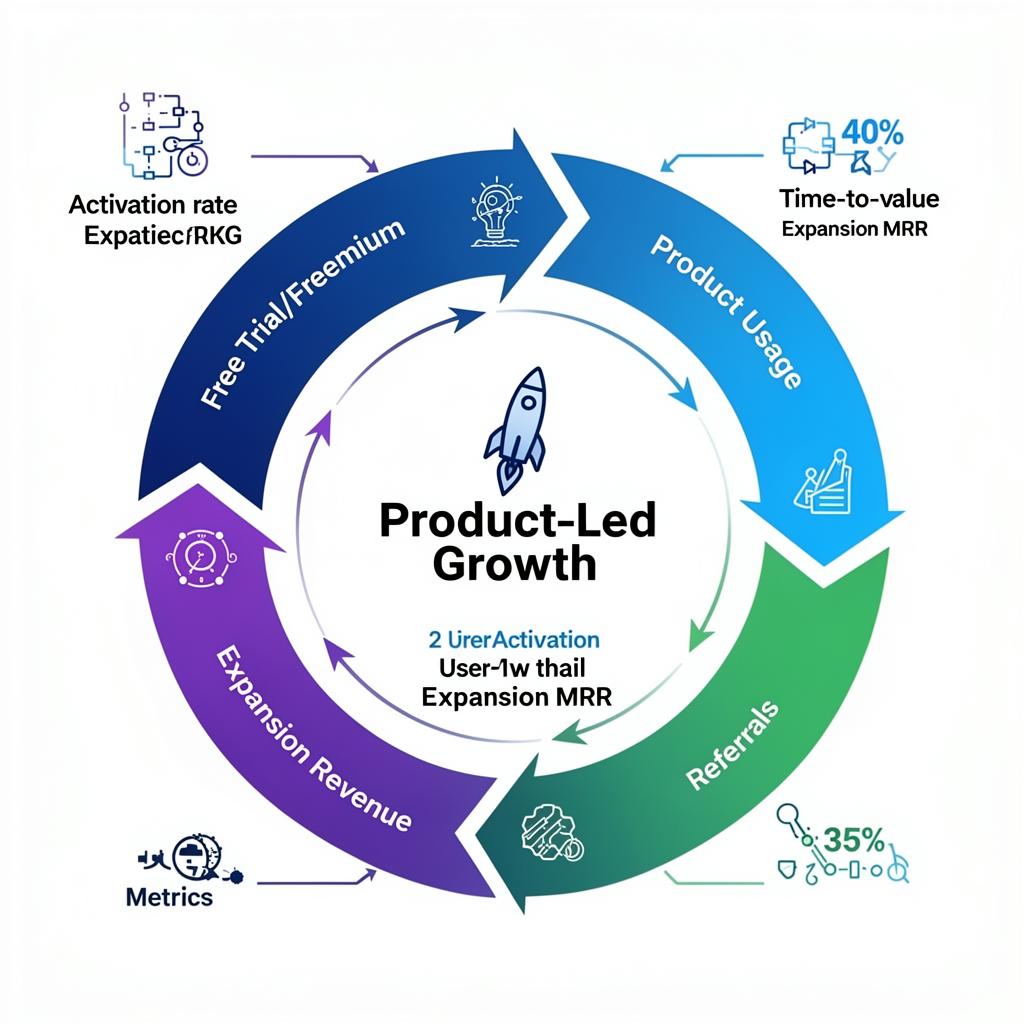
The PLG-SEO Connection
In a PLG model, SEO serves as the top-of-funnel acquisition engine that feeds qualified users into your product experience. The key metrics to optimize include:
Activation Rate
Percentage of signups who reach your "aha moment" within the trial period. Target: 40-60%
Time-to-Value (TTV)
How quickly users experience product value. Best-in-class: under 5 minutes
Expansion MRR
Revenue growth from existing customers through upsells and add-ons. Target: 20-30% of total MRR
SaaS Keyword Strategy: Beyond Generic Terms
Effective SaaS SEO requires a nuanced keyword strategy that maps to different stages of the buyer journey and product adoption lifecycle.
The SaaS Keyword Hierarchy
| Keyword Type | Example | Intent | Conversion Rate |
|---|---|---|---|
| Problem-Aware | "how to manage remote team communication" | Informational | 0.5-2% |
| Solution-Aware | "best team chat software" | Commercial Investigation | 2-5% |
| Product-Aware | "Slack vs Microsoft Teams" | Comparison | 5-10% |
| Brand | "Slack pricing" / "Slack login" | Transactional/Navigational | 10-25% |
| Feature-Specific | "slack workflow automation" | Feature Discovery | 15-30% |
Integration Keywords: The Hidden Goldmine
SaaS companies often overlook integration-focused keywords that capture users already invested in complementary tools:
- "[Your Product] + [Popular Tool] integration" — High intent, low competition
- "[Competitor] alternative for [specific use case]" — Captures switchers
- "[Your Product] API documentation" — Targets developers and power users
- "How to connect [Tool A] with [Tool B]" — Solution-oriented
Optimizing the SaaS Trial Conversion Funnel
SEO traffic is only valuable if it converts. Understanding and optimizing each stage of the trial funnel is critical for SaaS success.
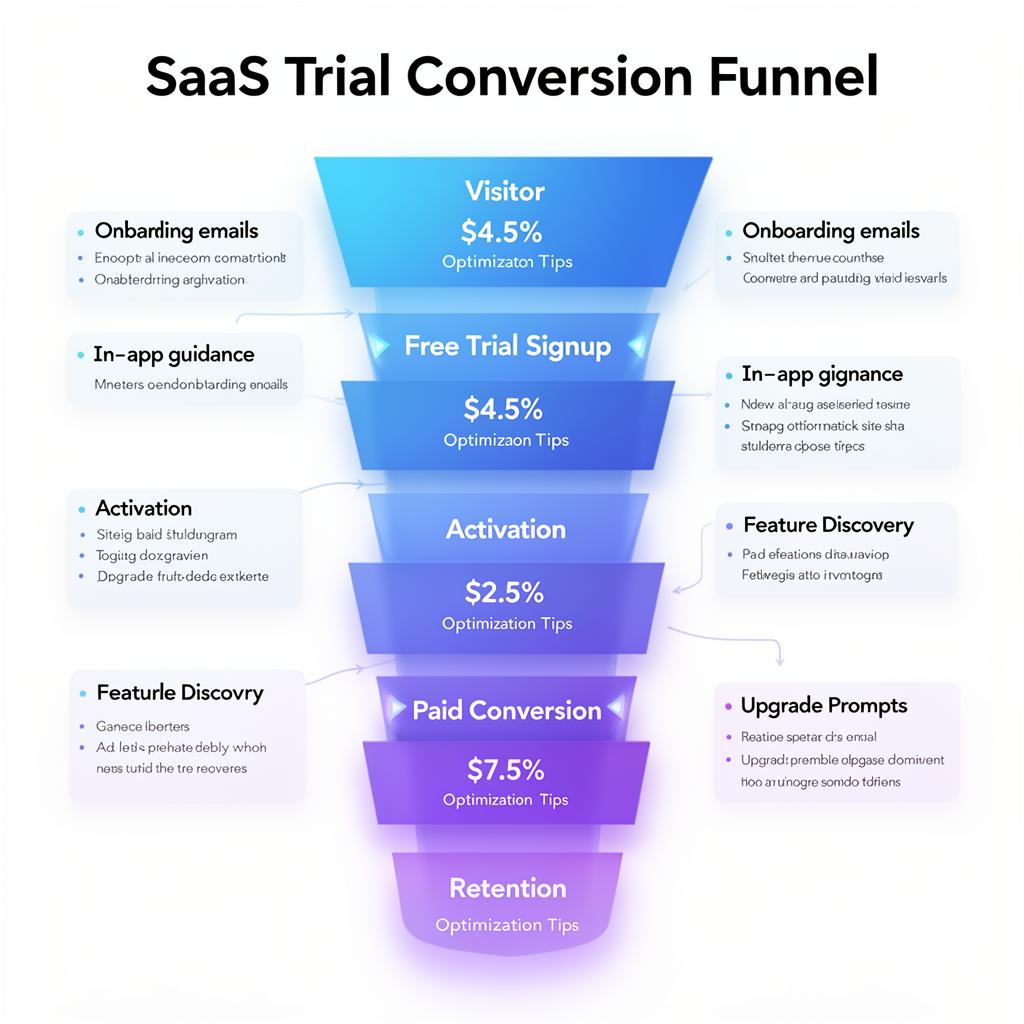
Stage-by-Stage Optimization
Stage 1: Visitor → Free Trial (Target: 3-8%)
- Clear value proposition above the fold
- Minimal form fields (email only for initial signup)
- Social proof: customer logos, review scores, user counts
- Risk reducers: "No credit card required," "Cancel anytime"
Stage 2: Signup → Activation (Target: 40-60%)
- Streamlined onboarding flow (5-7 steps max)
- Progressive profiling to personalize experience
- Quick wins within first 5 minutes
- Contextual help and tooltips
Stage 3: Activation → Engagement (Target: 60-80%)
- Feature discovery prompts based on usage patterns
- Triggered email sequences for inactive users
- In-app messaging for milestone celebrations
- Usage-based nudges toward key features
Stage 4: Engagement → Paid Conversion (Target: 15-25%)
- Value-based upgrade prompts (not time-based)
- Feature gating that demonstrates premium value
- Usage limit notifications with clear upgrade path
- Personalized pricing based on team size/usage
Building a SaaS Content Marketing Flywheel
The most successful SaaS companies don't just create content—they build content flywheels that generate compounding returns over time.
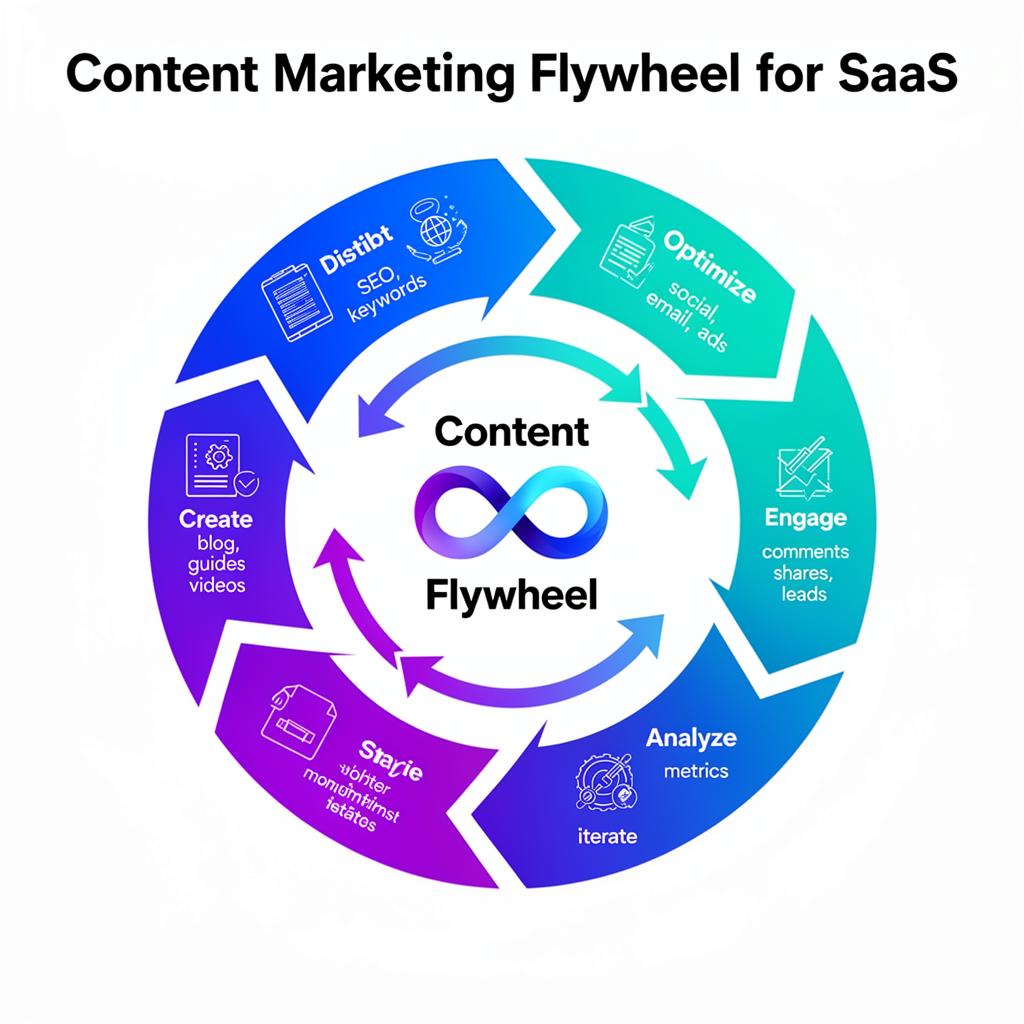
The Five Flywheel Stages
1. Create
Develop content that solves real problems for your target users:
- How-to guides and tutorials
- Industry benchmarks and research
- Templates and frameworks
- Case studies with specific metrics
2. Optimize
Ensure every piece of content is discoverable:
- Target specific keyword clusters
- Optimize for featured snippets
- Internal linking to product pages
- Schema markup for rich results
3. Distribute
Amplify reach beyond organic search:
- Email newsletter to existing users
- Social media with native content
- Partner co-marketing opportunities
- Community engagement (Reddit, Slack, Discord)
4. Engage
Turn readers into leads and users:
- Contextual CTAs within content
- Lead magnets and gated resources
- Interactive tools and calculators
- Comment and community building
5. Analyze & Iterate
Use data to improve continuously:
- Track content → trial → conversion attribution
- Identify top-performing content patterns
- Update and refresh underperforming pieces
- Scale what works, cut what doesn't
Technical SEO for SaaS Platforms
SaaS websites often have unique technical challenges that require specialized solutions.
JavaScript Rendering Considerations
Many SaaS marketing sites use React, Vue, or Angular. Ensure proper rendering for search engines:
- Server-Side Rendering (SSR) or Static Site Generation (SSG) for content pages
- Dynamic rendering for user-generated or frequently updated content
- Prerendering for critical landing pages
- Regular testing with Google's URL Inspection tool
App vs. Marketing Site Architecture
| Consideration | Recommendation |
|---|---|
| Domain structure | app.yourproduct.com for application, yourproduct.com for marketing |
| Login/signup pages | Noindex app pages, but index pricing and features |
| Help documentation | Keep on main domain (help.yourproduct.com or yourproduct.com/help) |
| Blog/resources | Always on main domain for SEO equity |
| API documentation | Subdomain okay (docs.yourproduct.com) or main domain subfolder |
Core Web Vitals for SaaS Sites
Page experience signals are particularly important for SaaS, where users expect fast, responsive interfaces:
Link Building Strategies for SaaS
SaaS companies have unique link building opportunities that leverage their product and data:
Product-Led Link Building
- Free tools and calculators — Build standalone tools that solve specific problems
- Embeddable widgets — Create shareable components users can add to their sites
- Integration partner pages — Cross-link with integration partners
- Open source contributions — Release helpful libraries or tools
Data-Driven Link Building
- Industry benchmarks — Aggregate anonymized user data into valuable reports
- Original research — Survey your user base on industry trends
- State of [Industry] reports — Annual publications that become reference material
- Trend analysis — Use product data to identify and report on market trends
Measuring SaaS SEO Success
Move beyond vanity metrics to measurements that connect SEO to revenue:
The SaaS SEO Metrics Hierarchy
| Level | Metrics | Why It Matters |
|---|---|---|
| Top of Funnel | Organic traffic, keyword rankings, impressions | Visibility and reach |
| Engagement | Time on page, pages/session, bounce rate | Content quality and relevance |
| Conversion | Organic trials, signup rate, activation rate | Lead generation effectiveness |
| Revenue | Organic MRR, CAC from organic, LTV of organic users | Business impact |
| Efficiency | Content ROI, organic CAC vs. paid CAC | Channel sustainability |
SaaS SEO Implementation Checklist
Foundation
- ☐ Define PLG metrics and targets
- ☐ Map keyword strategy to buyer journey
- ☐ Set up proper analytics tracking
- ☐ Audit technical SEO infrastructure
Content
- ☐ Build content flywheel system
- ☐ Create integration/comparison pages
- ☐ Develop free tools strategy
- ☐ Plan quarterly content themes
Conversion
- ☐ Optimize trial signup flow
- ☐ Implement activation tracking
- ☐ Set up triggered email sequences
- ☐ A/B test upgrade prompts
Measurement
- ☐ Track content → trial attribution
- ☐ Calculate organic CAC
- ☐ Monitor organic MRR contribution
- ☐ Report on content ROI monthly
Conclusion: Building Sustainable SaaS Growth
SaaS SEO is not a quick fix—it's a long-term investment that compounds over time. By combining product-led growth principles with systematic content marketing and rigorous conversion optimization, you can build an organic acquisition engine that delivers sustainable, profitable growth.
The key is to think beyond rankings and traffic. Focus on the entire journey from search query to paying customer, optimizing each touchpoint along the way. Build your content flywheel, nurture your trial users, and let the compound effects of great SEO work for your SaaS business.
Ready to Scale Your SaaS with SEO?
Our team specializes in SaaS SEO strategies that drive trial signups and MRR growth. Let's discuss how we can help you build a sustainable organic growth engine.
Get Your SaaS SEO Strategy